
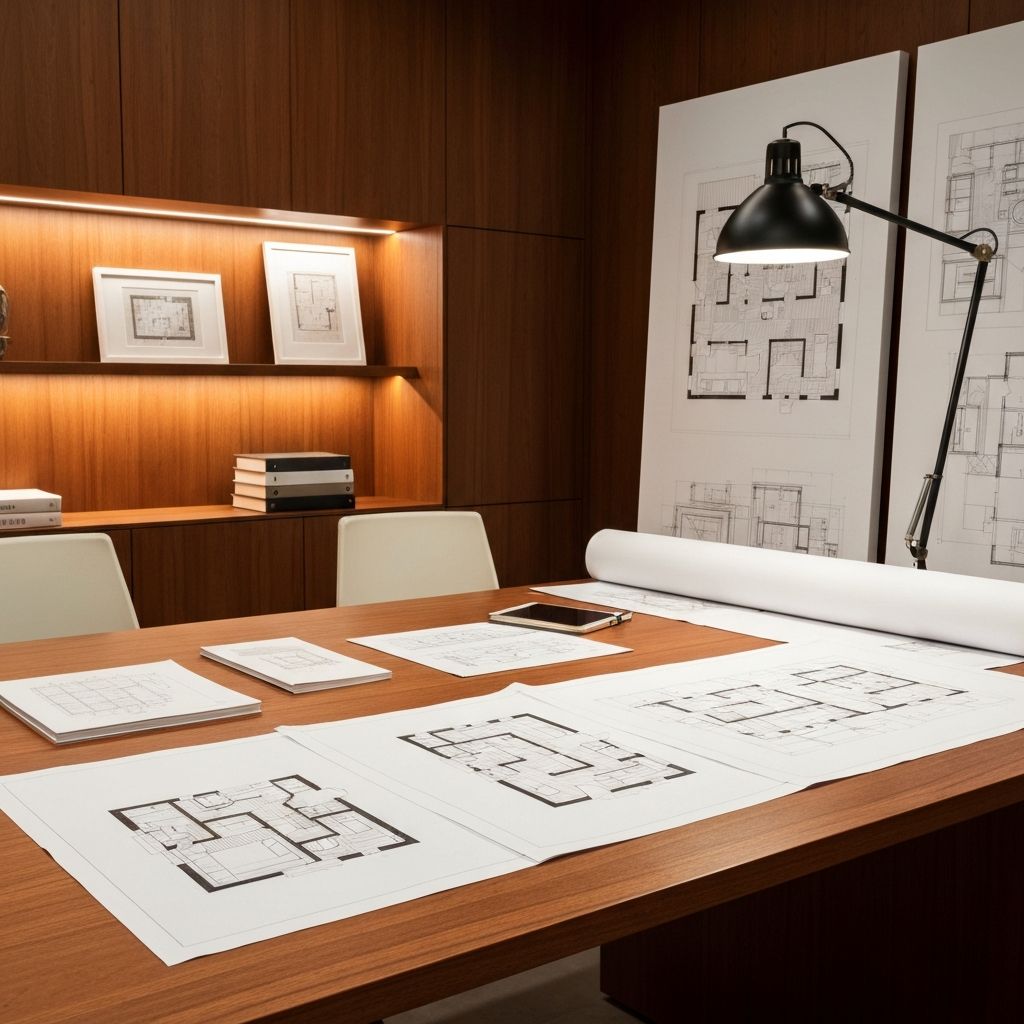
This article provides a five-part framework for evaluating residential floor plans, focused on circulation, zoning, proportions, light, and flexibility — the qualities that determine whether a home actually works for the people living in it.
Most homeowners evaluate floor plans the same way: bedroom count, bathroom count, square footage, and whether the kitchen has the features they want. These metrics are easy to compare across plans, which is why real estate listings rely on them.
The metrics also miss almost everything that matters.
A 4-bedroom, 3-bath, 3,200-square-foot home can be a great home or an exhausting home depending on a hundred design decisions that don't show up in the listing. Two homes with identical specs can produce wildly different daily experiences. The difference is in the floor plan — but only if you know how to read one.
This article walks through how a trained designer reads a floor plan. The framework has five parts.
“Most people evaluate floor plans by counting bedrooms. Designers evaluate them by asking how they'll feel to live in.”
1. Circulation: where people actually walk
Before you look at the rooms, look at the paths between the rooms. Trace them with your finger.
- How do you get from the front door to the kitchen? Through what? Past what?
- How do groceries get from the car to the pantry?
- How does laundry move from the bedrooms to the laundry room and back to the closets?
- Where do the kids walk when they come home from school?
- How do guests find the powder room without walking through private spaces?
Plans that work well have circulation that feels natural and stays out of the way. Plans that don't work well force daily life through awkward paths — through bedrooms, around islands, past private spaces — that create small frictions multiplied across a lifetime of living there.
When you trace circulation, you'll find that some paths are short and clean while others are weirdly long or pass through spaces they shouldn't. Note those. They're the friction points.
2. Zoning: the four pairs that matter
Every home has four pairs of opposites that need to be zoned thoughtfully:
The four zoning pairs
- Public vs. private. Where do guests go? Where do family members retreat? A plan that puts the primary bedroom right off the main living area sacrifices privacy for adjacency. A plan that buries the primary bedroom too far away creates daily distance. Neither is universally right; both should be deliberate.
- Loud vs. quiet. Kitchens and family rooms are loud. Bedrooms and home offices are quiet. Plans that put loud spaces directly next to quiet spaces — without buffer zones, sound-attenuating walls, or distance — create daily conflicts. The home office that shares a wall with the kitchen will be a worse home office.
- Active vs. resting. Mudrooms, garages, and entries are active. Living rooms and bedrooms are resting. Plans that mix these zones (mudroom opening directly into the dining room) create disorder; plans that separate them (mudroom feeding into a hallway with closet storage) create calm.
- Working vs. socializing. Home offices, kitchens used as workspaces, and laundry rooms are working spaces. Living rooms, dining rooms, and entertaining areas are social. Plans that locate working spaces where they're constantly visible to social spaces force you to either hide work or accept clutter.
A great floor plan handles all four pairs deliberately. A weak floor plan handles one or two and ignores the others.
3. Proportions: room sizes relative to function
Square footage tells you how big a room is. It doesn't tell you whether it's the right size for what you'll do in it.
A 12'x14' bedroom feels generous if it has a queen bed and a single dresser. The same room feels cramped if it has a king bed, two dressers, and a reading chair. Square footage didn't change. The relationship between size and function changed.
When you look at a floor plan, ask of each room:
- What furniture will live here?
- Will it fit comfortably with circulation paths around it?
- Are there at least 36 inches of walking space on the major paths through the room?
- Does the room have a focal point (a fireplace, a view, a bed wall) and is the furniture oriented to it?
- Are the proportions right for the room's function — a long narrow living room often works worse than a square one of equivalent square footage, because furniture grouping is harder.
Designers think about rooms in terms of furniture clearance, sight lines, and proportion. Homeowners often think about rooms in terms of square footage. The first approach predicts how the room will feel; the second doesn't.
4. Light and view: where natural light enters and what it illuminates
Look at the windows on the floor plan. Then look at what those windows are pointed at.
A bedroom with east-facing windows will be sunny in the morning. The same bedroom with west-facing windows will be hot in the afternoon. The same bedroom with north-facing windows will have soft, even light all day but no direct sun.
A kitchen with windows over the sink lets you watch the yard while doing dishes. A kitchen with windows behind the range loses the wall to the hood and forfeits the chance.
A living room with windows on three walls feels open and connected to the outside. A living room with windows on one wall feels like a box.
Floor plans that don't think about light produce homes that feel wrong without the homeowner being able to articulate why. Floor plans that think carefully about light produce homes that feel right in ways that are hard to describe but immediately noticeable.
When evaluating a plan, ask: where does morning light land? Where does afternoon light land? What rooms are dark, and is that okay for their function (bedrooms can be dark; kitchens shouldn't be)? What windows look at views worth looking at, and what windows look at the neighbor's siding?
5. Flexibility: how the plan handles 20 years of life
The home you build today will be lived in for decades. The family living there will change. Kids will be born, grow up, and leave. Aging parents may move in. Work-from-home patterns will shift. Mobility may decline.
A great floor plan accommodates these changes without major renovation. A weak floor plan locks in a single life stage.
Look for:
- A bedroom or office on the main floor (for guests now, for aging in place later)
- A bathroom configuration that allows for accessibility modifications (curbless showers, wider doorways) without rebuilding
- Spaces that can flex (a study that becomes a nursery that becomes a home office that becomes a guest room)
- Storage that can absorb the accumulation of decades of life
- Outdoor connections that work for current life and future life
Plans that anticipate flexibility cost almost nothing extra to design but add decades of value to the home. Plans that don't anticipate flexibility require expensive renovations every time life changes. (For more on this specifically, see our article on aging in place without making your home look like a hospital.)
How to use this framework
When you're looking at a floor plan — whether it's a plan an architect drew for you, a stock plan you're considering buying, or an existing home you're thinking about renovating — walk through the five parts in order:
- Trace the circulation. Where are the friction points?
- Check the four zoning pairs. Which are handled? Which aren't?
- Evaluate proportions. Will the rooms feel right for the function?
- Look at light. Where does it enter, and is that thoughtful?
- Consider flexibility. Will this plan still work in 20 years?
If you find significant problems in two or more areas, the plan needs work before construction. If you find problems in only one area, ask whether it's the area that matters most for your specific life.
The five questions in our Strategy Session often surface these exact issues — but the framework above lets you do a first-pass evaluation yourself, before deciding whether you need professional input.
One last thing
The hardest part about evaluating a floor plan is that the problems are invisible until you know how to look. A plan that has all five issues can still look beautiful. The renderings will be lovely. The square footage will check the boxes. The bedroom count will match what you asked for.
But you'll live in the home and feel that something is wrong, and not be able to say what.
This framework gives you the language. Use it before you build, not after.
Quick Answers
What makes a good residential floor plan?
Five things: clean circulation paths, deliberate zoning between public/private/loud/quiet/active/resting/working/socializing, room proportions that match how the spaces will be used, thoughtful natural light placement, and flexibility to accommodate how life changes over decades.
Why do bedroom count and square footage miss what matters in a floor plan?
They measure quantity, not quality. Two homes with identical bedroom counts and square footage can produce wildly different daily experiences depending on how the rooms relate to each other, how light enters, and how circulation works.
What's the most overlooked aspect of floor plan evaluation?
Circulation — the paths people actually walk between rooms. Plans that ignore circulation create daily friction multiplied across years of living there.
How do designers evaluate floor plans differently than homeowners?
Designers focus on circulation, zoning, proportions, light, and flexibility. Homeowners typically focus on bedroom count, square footage, and feature lists. Designers predict how a home will feel; homeowners often discover it after moving in.
When should I get professional help evaluating a floor plan?
When you find issues in two or more of the five framework areas, when the plan represents a significant financial commitment, or when you're not confident in your own ability to identify the issues. A Plan Review service evaluates plans against this kind of framework and provides specific feedback.